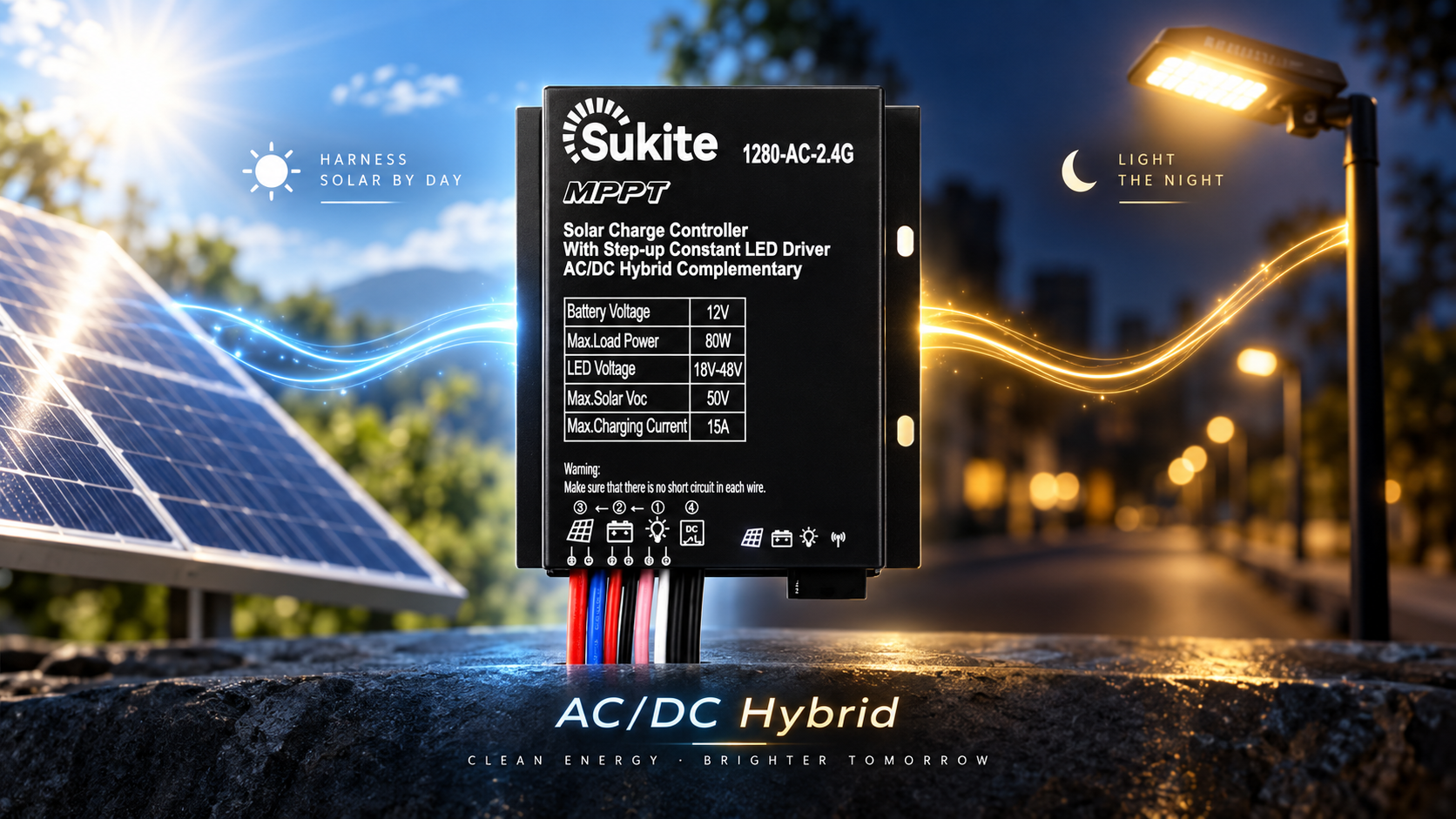


MPPT stands for "Maximum Power Point Tracking." It represents the next-generation upgrade from traditional solar charge controllers. In simple terms, a solar panel's output voltage and current constantly fluctuate due to changing irradiance, temperature, and other factors, causing its power output to vary. The core task of an MPPT controller is to act as a highly sensitive "tracker," continuously detecting the panel's operating voltage and adjusting it to the optimal point where voltage and current produce the maximum power, thereby ensuring the battery is always charged at peak efficiency.
A simple analogy helps: a traditional PWM (Pulse Width Modulation) controller is like a manual transmission car. Regardless of engine RPM (sunlight), the gear ratio (charging parameters) is mostly fixed, so it cannot operate at peak efficiency at all times. An MPPT controller, by contrast, is like an intelligent continuously variable transmission (CVT) vehicle. It automatically shifts to the optimal gear based on road conditions (light intensity), ensuring the engine always runs within its most efficient RPM range.
At the technical level, an MPPT controller incorporates a DC-DC conversion circuit. Using algorithms like Perturb and Observe (P&O), it continuously fine-tunes the panel's operating voltage to perfectly match the battery voltage, effectively converting the otherwise "wasted" excess voltage into additional charging current. Studies show that MPPT-based systems can boost charging efficiency by 20% to 30% compared to traditional controllers, and in some extreme cases, by as much as 50%.
The value of MPPT controllers is especially pronounced in scenarios where sunlight conditions fluctuate dramatically.
Off-grid Power in Remote Areas: In mountainous regions and grasslands beyond the reach of power grids, MPPT controllers are critical for building stable off-grid systems. In Mongolia, for example, herders traditionally struggled with harsh -35°C winters and unstable power supply. By deploying a 192V high-voltage MPPT controller paired with a PV storage system, a 20kW off-grid power station not only operates reliably in extreme cold but also saves herders approximately $4,000 annually in diesel costs. Similarly, at a national forest park protection station in Vietnam, an MPPT controller combined with a 40kW solar system has completely resolved previous power shortages and peak summer demand issues.
Residential and C&I Solar: On residential rooftops and commercial/industrial facilities, MPPT controllers effectively cope with morning/evening light variations and cloud shading, maximizing the yield of each panel and shortening the payback period.
Integration with Emerging Technologies: As technology advances, MPPT controllers are deeply integrating with IoT and AI. For instance, in a solar e-bus charging station project in Egypt, researchers have already implemented IoT-based remote monitoring and real-time data integration for MPPT systems. Looking ahead, optimizing MPPT algorithms with AI and leveraging wide-bandgap semiconductors to reduce device footprint will be major trends.
The rapid market growth underscores the value of MPPT technology. According to industry data, global MPPT solar charge controller sales reached approximately **$1.47 billion USD in 2025**, with projections to grow to $2.379 billion by 2032. Currently, the global market is led by well-known brands such as Victron Energy, Morningstar, EPEVER, and Schneider Electric.
For consumers and system integrators, the following considerations are key when selecting an MPPT controller:
In summary, the MPPT solar charge controller is no longer just a simple "charge protector" — it has become the core technology for enhancing the overall efficiency of PV systems. As costs continue to decline and intelligence levels rise, it will become an indispensable "smart brain" for every solar installation, driving the global green energy transition forward with renewed momentum.


Fill out the form below and our team will get back to you within 24 hours.
Your inquiry has been submitted successfully. Our team will contact you within 24 hours.