

In off-grid solar applications, there is a category of demand fundamentally different from ordinary lighting systems: surveillance cameras need to record around the clock, communication equipment must maintain uninterrupted operation, and certain lighting scenarios require continuous day-and-night operation. What these devices share is a common requirement — they cannot only work when the sun is shining, and they cannot "go on strike" when battery voltage fluctuates.
Traditional solar street light controllers typically activate load output only at night, shutting it off during the day to conserve energy. This logic makes perfect sense for streetlights that "only light up after dark," but it fails to meet the needs of surveillance and communication equipment that must run 24/7.
The Sukite 1240-CK was designed specifically to fill this gap. The "CK" suffix in the model number directly points to its core function — 24-Hour Constant Voltage Output. This means the controller's load terminal maintains stable output around the clock, unaffected by light conditions, timer settings, or battery voltage fluctuations — providing what is effectively a true "uninterruptible power supply" for connected devices.
The specification table on the product panel clearly reveals the 1240-CK's design logic — every parameter revolves around three keywords: continuous, stable, and reliable.
12V battery system is the most universal voltage platform in the security surveillance and communication equipment sector. The vast majority of surveillance cameras, communication relay devices, and small off-grid lighting systems are designed around 12V DC power, offering a mature ecosystem and abundant choices. The 1240-CK's precise positioning on this platform means it can work plug-and-play with a vast array of 12V devices, without the need for additional voltage conversion stages.
Maximum charging current of 10A gives the controller ample "energy throughput" capability. For a 12V battery system, 10A charging current corresponds to a theoretical maximum charging power of approximately 120W. This means it can support PV array configurations in the 100W to 120W range, fully capable of meeting the daily energy demand of a 40W load running 24 hours a day under good sunlight conditions — while maintaining a healthy energy reserve in the battery.
Maximum load power of 40W forms a well-matched relationship with the charging capability. In security surveillance scenarios, a typical high-definition camera system (including the camera body, infrared illumination, and pan-tilt mechanism) consumes between 15W and 30W; small communication relay devices also typically draw 20W to 40W. The 40W load capacity provides ample power headroom for the system, supporting multiple parallel devices or future system expansion.
Maximum solar open-circuit voltage of 50V provides substantial flexibility for PV array configuration. Users can flexibly choose 12V or 24V solar panels in series or parallel combinations based on actual light conditions and installation space. The 50V voltage tolerance provides a generous safety margin for the controller, effectively reducing the risk of equipment damage from voltage spikes caused by intense sunlight or no-load conditions.
12V LED output voltage matches the battery's nominal voltage, achieved through the controller's internal voltage regulation circuit. This is one of the 1240-CK's core technical differentiators: it does not simply pass battery voltage directly to the load, but through precise voltage regulation, ensures the load device consistently receives stable, clean 12V operating power even as battery voltage fluctuates (approximately 10.8V to 14.4V).
For security surveillance and communication equipment, the core metric of power supply quality is not "how fast it charges," but "how stably it supplies."
A 12V battery's voltage fluctuates significantly across its charge/discharge range — approximately 14.4V at full charge, down to about 10.8V at the under-voltage protection point. If a load device is connected directly to the battery, it faces the risk of voltage instability. For precision electronic equipment, such fluctuations can cause a range of problems: surveillance cameras may restart or experience image anomalies due to voltage swings, communication equipment may be interrupted by under-voltage conditions, and long-term operation may accelerate electronic component aging.
The 1240-CK incorporates a voltage regulation circuit at the load terminal, stabilizing output at 12V (within ±3% accuracy) to provide clean, stable operating power for connected devices. The value delivered by this function is multifaceted:
Guaranteed stable device operation — cameras won't restart or go black due to voltage fluctuations, communication equipment won't be interrupted by under-voltage conditions, and the system truly achieves "always-on" operation.
Extended device lifespan — avoids the impact and damage to precision electronic components caused by voltage fluctuations, reducing equipment failure rates and replacement costs.
Broader device compatibility — the regulated output enables the controller to work with a wider range of devices that require voltage stability, expanding application possibilities.
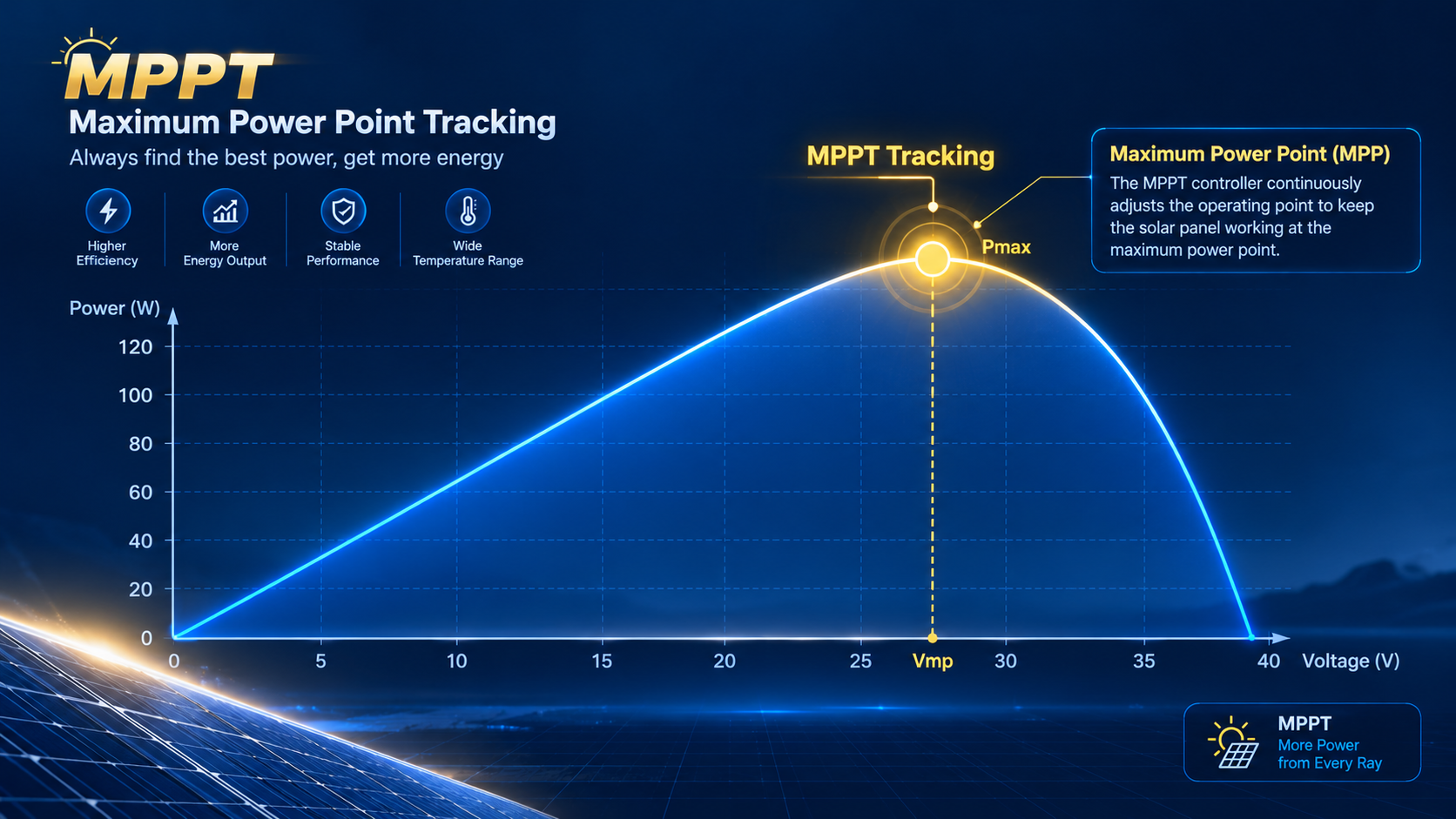
As an MPPT solar charge controller, the 1240-CK incorporates a maximum power point tracking algorithm — the fundamental distinction from traditional PWM controllers.
Solar panels exhibit non-linear output characteristics: as output voltage varies, there exists a maximum power point whose position shifts in real time with changes in irradiance, temperature, and shading. The 1240-CK's MPPT algorithm continuously monitors the panel's voltage and current, dynamically adjusting the operating point through intelligent algorithms to ensure the PV array consistently operates at maximum power output.
Compared to traditional PWM controllers, MPPT technology can improve charging efficiency by 20% to 30% . For off-grid systems requiring 24-hour continuous operation, this efficiency advantage carries special significance: with the same PV panel configuration, an MPPT controller can harvest more daily energy, ensuring the battery charges faster and sustains equipment operation longer — especially during consecutive overcast or rainy days, this advantage directly determines whether the system can autonomously ride through power-deficient periods and keep devices powered without interruption.
With its 12V system, 10A charging, 40W load, and 24-hour constant voltage output specifications, the 1240-CK offers distinct advantages in the following application scenarios.
Security surveillance solar power systems represent the 1240-CK's core target market. In remote areas, construction sites, perimeter security, and traffic checkpoints, surveillance cameras often face the dilemma of "demand exists, but grid power doesn't." An off-grid power system comprising solar panels, a battery, and the 1240-CK can provide round-the-clock stable power for cameras. Taking a typical high-definition PTZ camera (including pan-tilt and infrared illumination, consuming approximately 25W to 30W) as an example, paired with a 120W solar panel and a 100Ah battery, year-round uninterrupted operation can be achieved.
Communication base stations and relay equipment are equally well-served. Small communication base stations and relay devices on mountaintops, islands, and remote areas require stable off-grid power supply. The 1240-CK's 24-hour constant voltage output ensures communication equipment receives stable 12V power during battery voltage fluctuations, safeguarding uninterrupted communication links.
Small off-grid continuous lighting systems — for special locations requiring 24-hour illumination (such as tunnels, basements, and emergency passages), or landscape lighting projects aiming for "daytime illumination" effects, the 1240-CK is an ideal controller choice. No complex timer or photocell configuration is needed — the load terminal remains active at all times.
Continuous power for RVs and mobile applications — refrigerators, communication equipment, and security systems in RVs that require continuous operation can also benefit from the 1240-CK's constant voltage output capability.
The Sukite 1240-CK MPPT solar charge controller combines "high-efficiency MPPT charging" with "24-hour constant voltage output," precisely addressing the core needs of continuous power supply scenarios such as security surveillance and communication base stations. It is not an ordinary solar street light controller — it is an off-grid power control core engineered for "uninterrupted operation" requirements.
For system integrators and contractors planning remote surveillance systems, off-grid communication sites, or solar projects requiring 24-hour power supply, the 1240-CK offers a practical pathway to simplified system design, guaranteed power quality, and reduced maintenance costs.
Model: Sukite 1240-CK MPPT Solar Charge Controller
Core Functions: MPPT Maximum Power Point Tracking + 24-Hour Constant Voltage 12V Output
Target Applications: 12V Security Surveillance, Communication Base Stations, 24-Hour Off-Grid Lighting Systems (≤40W Load)
Key Specifications: Max. Charging Current 10A / Max. Solar Voc 50V / Max. Load Power 40W
Manufacturer: Dongguan Sukite New Energy Lighting Co., Ltd. (Sukite)
Fill out the form below and our team will get back to you within 24 hours.
Your inquiry has been submitted successfully. Our team will contact you within 24 hours.