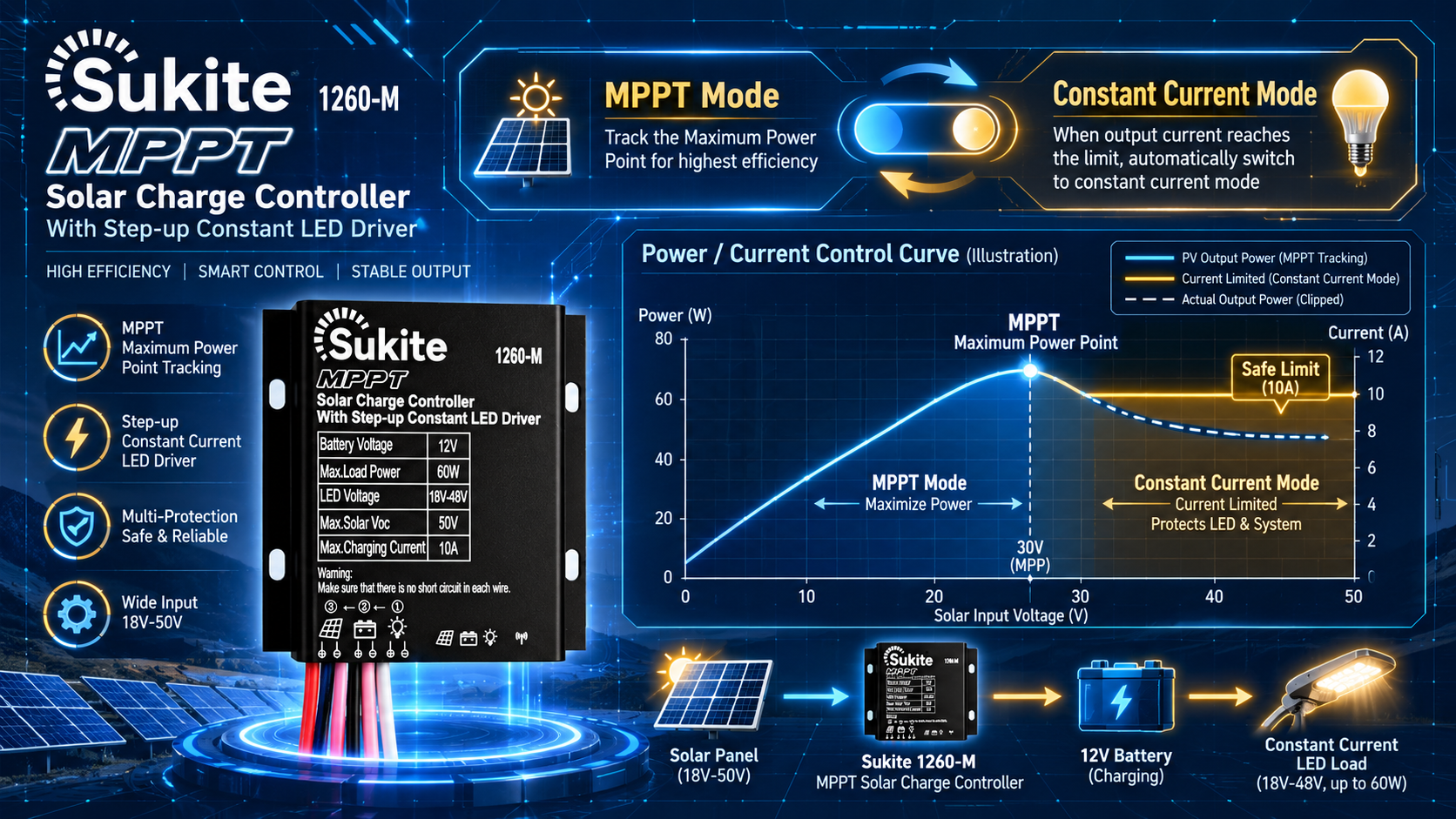


In solar systems, one of the most common questions users ask is: “My solar panel is rated at 100W, why is the actual charging power only 70W?” The answer often lies in the electrical characteristics of the solar panel — its output power is not fixed, but fluctuates in real time with changes in sunlight, temperature, and load. At any given moment, there exists a “maximum power point” where the product of voltage and current reaches its peak. The core task of an MPPT (Maximum Power Point Tracking) controller is to act like a person constantly adjusting a faucet, keeping the solar panel operating near this peak at all times.
Imagine a pipe connecting to a water tank. If you open the faucet too wide, the water flows fast, but the pipe resistance also increases, and the actual water output may actually decrease. If you open it too little, the water flows slowly, and the volume per unit time is insufficient. Only at a specific opening level does the combination of flow speed and pipe resistance reach its optimum — delivering the maximum volume of water per unit time.
Solar panels work on a similar principle. A solar panel has a “current-voltage curve”: when voltage is low, current is high; as voltage rises, current gradually declines. The product of the two (power) reaches its maximum at a specific voltage point — this is the “Maximum Power Point” (MPP). The job of an MPPT controller is to continuously adjust the solar panel’s operating voltage, keeping it at that point where the “product is greatest.”
Patent literature states that an MPPT controller is not just a high-efficiency DC/DC converter, but an intelligent control system that can increase solar array output power by approximately 19% to 35% . This means that with the same solar panel, an MPPT controller can charge significantly more energy into the battery than a traditional PWM controller.
The maximum power point is not a fixed voltage value. It moves in real time as light intensity, ambient temperature, and load conditions change.
When light intensity increases: The solar panel‘s current increases, and the maximum power point shifts toward higher voltage. When light intensity decreases: Current decreases, and the maximum power point shifts toward lower voltage. When temperature rises: The solar panel’s voltage drops, and the maximum power point shifts toward lower voltage.
This means that if the controller does not “track” this point, the solar panel may operate at a state where “power is not at maximum.” For example, in early morning or late afternoon, when light is weak, the maximum power point voltage is lower. If the controller still operates at the noon voltage setting, the solar panel cannot deliver its due power.
The MPPT algorithm inside the controller (such as Perturb and Observe, or Incremental Conductance) continuously monitors the solar panel‘s voltage and current, observing the direction of power change through small voltage perturbations, then determines whether the maximum power point is moving toward higher or lower voltage, and adjusts the operating point accordingly. This process occurs thousands of times per second, ensuring the solar panel always “tracks” the maximum power point.
Many users assume that “a solar panel rated at 100W will produce 100W.” In reality, without MPPT tracking, a solar panel may only deliver 70% to 80% of its rated power.
Take a typical 12V system as an example: a 100W solar panel‘s maximum power point voltage (Vmp) is typically around 18V. If connected directly to a 12V battery (charging voltage approximately 13.8V-14.4V), the solar panel will be “pulled” to operate near the battery voltage, and output power may only be 70W-80W. The remaining 20W-30W is wasted.
MPPT controllers use DC-DC conversion circuits to convert the solar panel’s “excess” voltage into additional charging current. Voltage decreases, but current increases, and total power remains essentially unchanged — this is the core principle behind MPPT‘s ability to harvest 20%-30% more energy than PWM.
This gap is especially pronounced in cold weather. Low temperatures raise the solar panel’s Vmp, widening the “voltage differential” with the battery, giving MPPT more “excess voltage” to convert. In hot weather, the solar panel‘s temperature rises, Vmp drops, the voltage differential narrows, and MPPT’s conversion headroom shrinks accordingly.
MPPT tracking precision and speed depend on the controller‘s internal algorithms and hardware design.
At the algorithm level: The traditional Perturb and Observe (P&O) method performs well under stable light conditions, but under rapidly moving clouds or partial shading, it can get “stuck” on a local peak, mistakenly believing it has found the maximum power point. High-end controllers employ improved algorithms (such as fuzzy logic control or particle swarm optimization) that can accurately locate the global maximum power point even under complex light conditions.
At the hardware level: MPPT tracking speed is limited by sampling precision and switching frequency. High-precision ADCs (analog-to-digital converters) measure voltage and current more accurately, and higher switching frequency MOSFETs adjust the operating point faster.
Tracking efficiency: Industry standards require MPPT tracking efficiency to reach 99% or higher. This means that 99% of the time, the controller can accurately lock onto the maximum power point. Every 1 percentage point improvement in tracking efficiency translates into measurable energy gains for large-scale PV systems.
Understanding the “maximum power point” concept has three practical implications for solar system users:
First, understanding where MPPT’s “premium” comes from. MPPT controllers typically cost 3-5 times as much as PWM. That premium buys the ability to “harvest 20%-30% more energy.” In scenarios with larger system power and highly variable sunlight, the extra energy harvested typically pays back the price difference within 1-2 years.
Second, understanding “why charging continues on cloudy days.” On cloudy days, although light intensity drops, the solar panel‘s output voltage decreases less than its current. The voltage differential still exists. As long as Vmp remains above battery voltage, MPPT has “excess voltage” to convert. Charging current becomes smaller, but it doesn’t drop to zero.
Third, understanding “why MPPT is more valuable in winter.” Low temperatures raise the solar panel‘s Vmp, widening the voltage differential and giving MPPT more conversion headroom. For systems operating in temperate or cold regions, MPPT’s cost-effectiveness is especially pronounced in winter.
What MPPT controllers “track” is the maximum power the solar panel can deliver at any given moment. It is like a person constantly adjusting a faucet to keep the water flow (power) at its maximum. Understanding this concept explains why the same solar panel, paired with an MPPT controller versus a PWM controller, can charge vastly different amounts of energy into the battery.
For Sukite, from the 3229-G to the 24200-M-2.4G, every MPPT controller in the product line has the same core task: keep the solar panel operating at its maximum power point, and extract the maximum value from every ray of sunlight.
Fill out the form below and our team will get back to you within 24 hours.
Your inquiry has been submitted successfully. Our team will contact you within 24 hours.