

In solar systems, many users habitually keep their original controller settings after switching battery types. They swap a lead-acid battery for a lithium battery, but the controller stays the same, and the parameters stay the same. It seems convenient — but the cost can be significantly shortened battery life, or even safety hazards.
Lead-acid and lithium batteries have fundamentally different charging characteristics. Understanding these differences explains why controllers need a dedicated lithium battery mode, rather than “just setting a voltage.”
The charging process for lead-acid batteries typically involves four stages: Bulk, Absorption, Float, and Equalize.
The first three stages are similar to most batteries: fast charging with high current, then holding a constant voltage to let current gradually decline, and finally a tiny current to maintain full charge. But the fourth stage — Equalize — is unique to lead-acid.
Equalization applies a high-voltage pulse of 15.0V to 15.5V (for a 12V system) for a period of time. This high voltage “stirs” the electrolyte, dissolves sulfation crystals on the battery plates, and restores capacity. For lead-acid batteries that operate in partial state-of-charge for long periods, periodic equalization is an important means of extending lifespan.
But here‘s the problem: this high-voltage pulse is fatal to lithium batteries.
Lithium batteries typically require only two stages of charging: constant current fast charging, followed by constant voltage once the saturation voltage is reached, with current gradually declining to zero.
Lithium batteries don’t have “sulfation” issues, so they don‘t need equalization at all. More critically, the internal structure of lithium batteries is completely different from lead-acid. When a lithium battery is subjected to a voltage exceeding its rated limit, internal pressure rises sharply, the electrolyte may decompose and generate gas, leading to swelling, permanent performance degradation, and even thermal runaway.
The equalization voltage for lead-acid batteries (15.0V-15.5V) is far above the safety limit for a nominal 12V lithium iron phosphate battery (typically around 14.6V). If a controller still performs equalization while in lithium mode, the consequences could be severe.
This is why lithium batteries typically need only two stages: constant current fast charging and constant voltage finishing. Some lithium battery systems (especially LiFePO₄ with a BMS) don’t even require complex stage management from the controller — the BMS takes over charging control itself.
Understanding the different charging curves of lead-acid and lithium batteries explains why controllers cannot treat them the same.
The core of lead-acid mode is “equalization”: The controller needs to periodically apply high-voltage pulses to dissolve sulfation and restore capacity. But the timing, duration, and voltage of these pulses must be precisely controlled, or overcharging may occur.
The core of lithium mode is “protection”: The controller must strictly limit the maximum charging voltage, prohibit any form of high-voltage pulses, and ensure the battery is not damaged by overvoltage. At the same time, the charging cut-off voltage accuracy requirements for lithium batteries are higher — a difference of 0.1V could mean the difference between “fully charged” and “overcharged.”
If a controller lacks a dedicated lithium mode and the user forgets to change parameters after swapping batteries, the controller may continue operating on lead-acid logic. The result: the lithium battery is repeatedly subjected to high-voltage pulses, internal pressure rises, capacity degradation accelerates, and lifespan may plummet from the designed 2,000 cycles to just a few hundred.
First, changing batteries requires changing modes. Switching from lead-acid to lithium, or vice versa, requires the controller to be switched to the corresponding battery type mode. This is not an “option” — it‘s a “must.”
Second, don’t just look at voltage — look at battery type. A 12V lead-acid battery and a 12V LiFePO₄ battery have the same nominal voltage, but completely different charging curves. Selecting “12V” on the controller is not enough — you also need to explicitly select “lead-acid” or “lithium.”
Third, a lithium battery‘s BMS cannot replace correct controller settings. Although lithium batteries typically have a BMS (Battery Management System) for overvoltage protection, the BMS is the “last line of defense” and should not be triggered frequently. Correct controller settings are the first line of defense for battery protection.
Lead-acid and lithium batteries may both be “batteries,” but their charging logic is completely different. Lead-acid needs “equalization” to stay healthy; lithium needs “protection” to avoid damage. If a controller cannot distinguish between the two, it‘s like using diesel engine maintenance practices on a gasoline engine — problems may not show immediately, but the cost will eventually be paid.
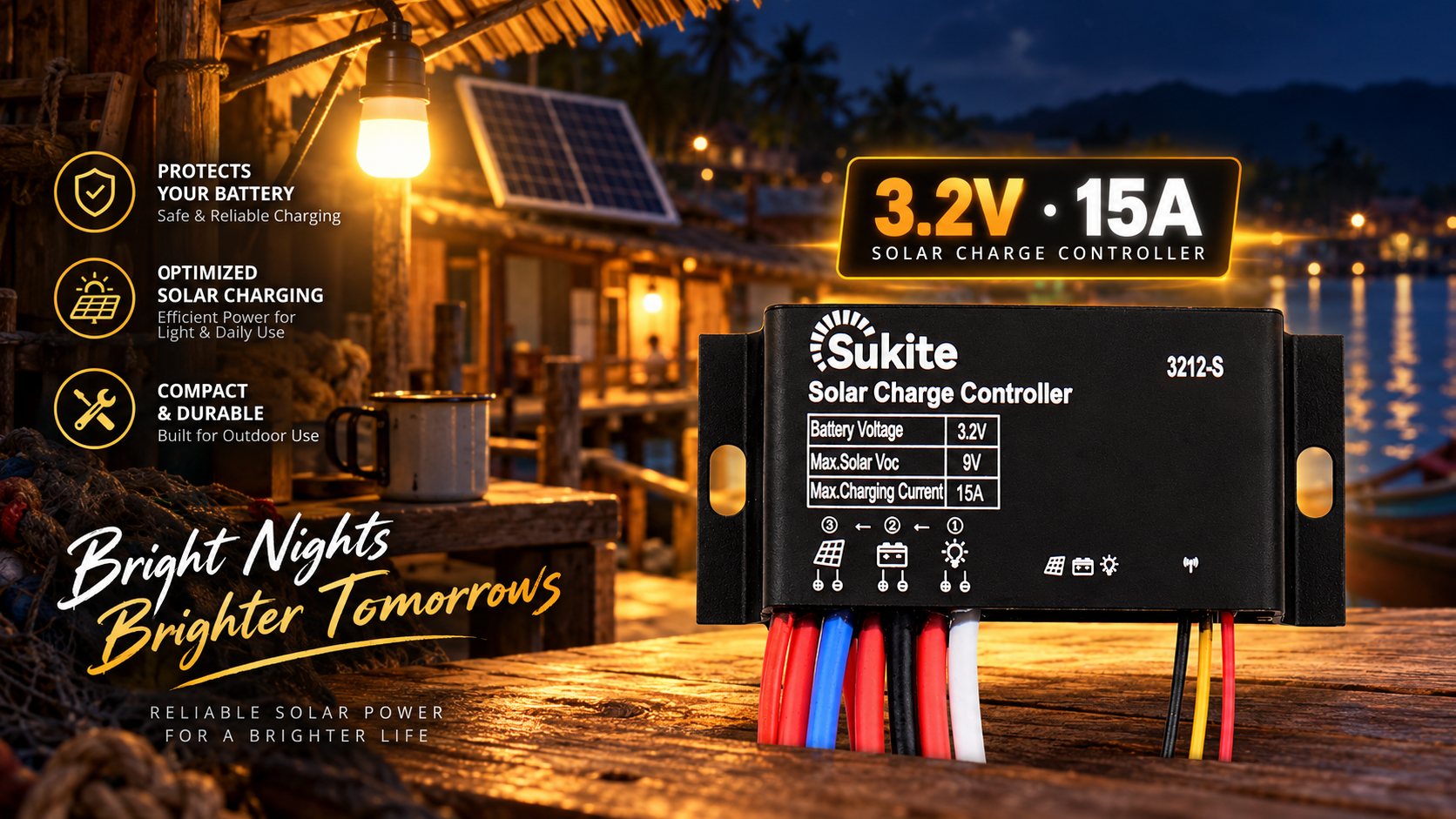
For Sukite, the 3.2V LiFePO₄ series (such as the 3229-G and 3240-G) is specifically optimized for lithium battery characteristics, with charging curves completely independent from lead-acid mode. Choosing the right mode means choosing longer battery life and safer system operation.
Fill out the form below and our team will get back to you within 24 hours.
Your inquiry has been submitted successfully. Our team will contact you within 24 hours.