

1. Core Working Principle Differences
A PWM (Pulse Width Modulation) controller represents a more traditional technical approach. It works essentially like a switch — when the battery voltage is low, the solar panel is directly connected to the battery; when the battery approaches full charge, the current is cut off or reduced. This method is simple, reliable, and cost-effective, but it cannot fully utilize the solar panel's power generation potential, as the panel's operating voltage is "pulled down" to the battery voltage level, resulting in some power loss.
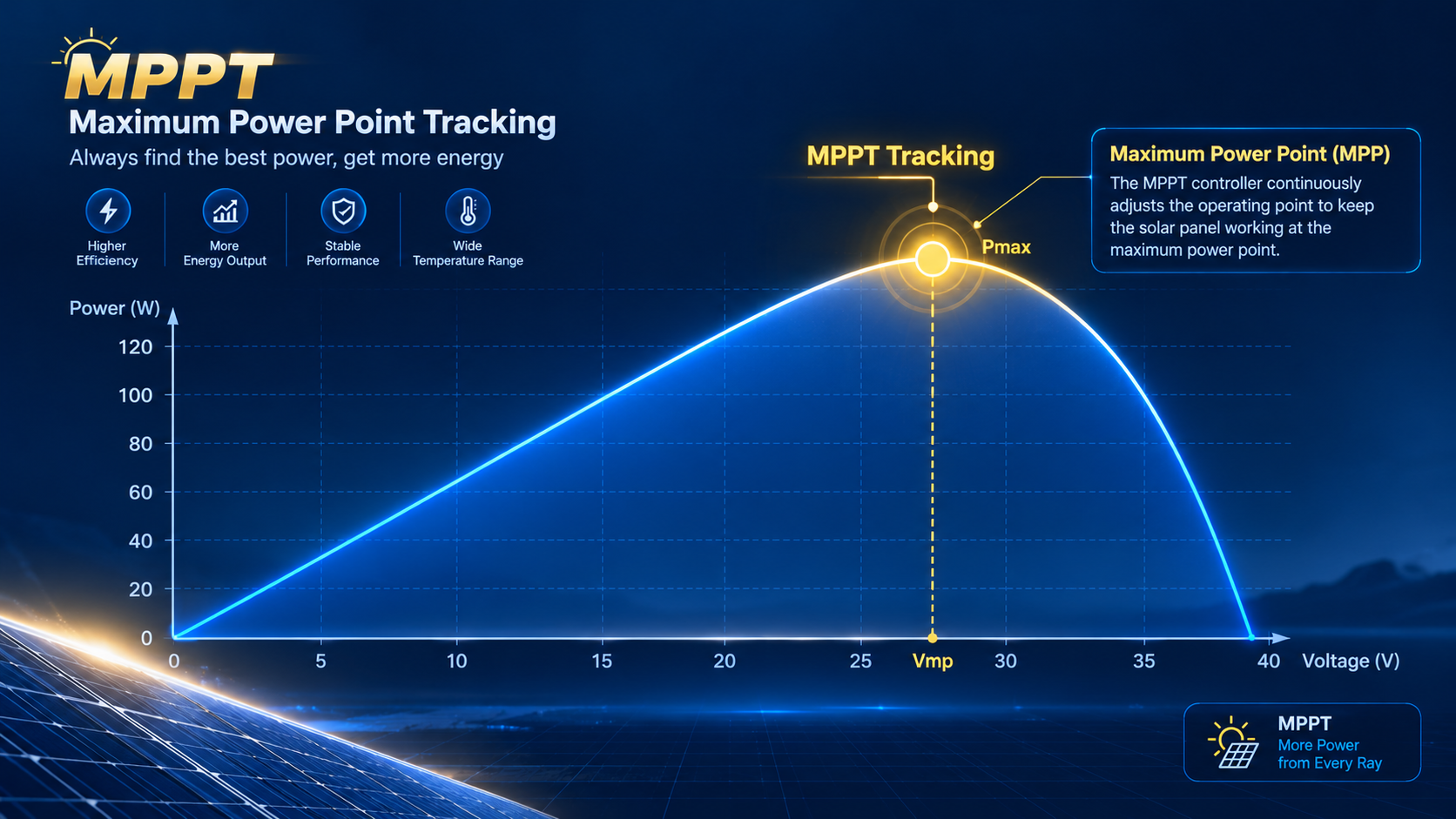
An MPPT (Maximum Power Point Tracking) controller, on the other hand, is more "intelligent." It incorporates a built-in DC-DC converter that continuously tracks the optimal voltage-power point of the solar panel, converting the panel's higher output voltage to the appropriate charging voltage for the battery without wasting excess voltage energy. In simple terms, MPPT acts as a "voltage adapter," ensuring that both the solar panel and the battery always operate at their optimal matching state.
2. Performance Comparison in Real-World Applications
In terms of charging efficiency, PWM controllers typically achieve around 75% to 85%, whereas MPPT controllers can reach approximately 92% to 99% — a significant performance gap that directly impacts the overall energy harvest of the system.
When it comes to solar panel utilization, PWM controllers are inherently voltage-limited, meaning the panel's operating voltage is constrained by the battery voltage, resulting in lower overall utilization. MPPT controllers, by contrast, continuously track the maximum power point and maintain optimal power output under varying conditions.
Regarding compatible panel voltage, PWM controllers require the solar panel voltage to closely match the battery voltage (for example, a 12V system must use a 12V panel). MPPT controllers offer far greater flexibility, supporting high-voltage panels — such as 36V or even 48V panels — to charge a 12V battery, which also helps reduce line losses in long-distance installations.
In cold weather conditions, PWM controllers tend to experience a further drop in efficiency. MPPT controllers, on the other hand, gain a greater advantage in low-temperature environments due to their superior high-voltage compensation capabilities, making them more suitable for regions with harsh winters.
As for cost, PWM controllers are relatively affordable and budget-friendly. MPPT controllers come at a higher price point — roughly 1.5 to 3 times that of PWM — but the additional upfront investment is often justified by the long-term energy gains and system longevity.
Note: The above figures are general industry reference ranges; actual values vary by brand and model.
3. Selection Guidelines: Choose Based on Actual Needs
When to prioritize a PWM controller?
When to opt for an MPPT controller?
4. The "Hidden Costs" Often Overlooked
Beyond the controller's price tag, we recommend considering the following factors:
Closing Remarks
There is no absolute "better" or "worse" between MPPT and PWM — the key lies in whether the choice aligns with the project's actual requirements and conditions. If your project prioritizes long-term stability and high ROI, MPPT is undoubtedly the superior choice; if budget is constrained and the system is relatively simple, the time-tested PWM solution is more than adequate.
We are committed to providing professional and reliable control solutions for our customers. Whether you need MPPT or PWM products, we offer mature and stable options. For any selection-related questions or specific project requirements, please feel free to reach out to our technical support team — we are happy to provide one-on-one professional advice.
(This article serves as a general technical reference only. Final selection should be based on a comprehensive evaluation of your specific project conditions.)
Fill out the form below and our team will get back to you within 24 hours.
Your inquiry has been submitted successfully. Our team will contact you within 24 hours.