

In conventional solar street light systems, two separate devices are typically required: a controller (either MPPT or PWM) for battery charge management, and a standalone LED driver power supply to operate the luminaire. This split-component design not only increases equipment procurement costs but also introduces a host of practical challenges, including complex wiring, multiple potential failure points, and limited installation space.
The Sukite 1230-G was designed specifically to address these pain points. By integrating both charge control and LED driving functions into a single device, it achieves end-to-end closed-loop control across the entire system chain — from "solar panel input" to "battery management" and onward to "LED light output." Users need only connect three sets of cables — solar panel, battery, and LED string — to complete the entire electrical connection of the street light system, dramatically reducing installation complexity and system failure rates.
Decoding the model number: "1230" denotes the product series and power class, while the suffix letter "G" clearly indicates the device's core feature — a built-in step-up constant current LED driver. This means the controller can boost the 12V battery voltage to the 18V to 36V range required by LED strings, while delivering precise constant current output to ensure stable brightness and reliable operating life regardless of battery voltage fluctuations.
The 1230-G's technical specifications clearly define its target application — small-to-medium power LED solar street lights and similar 12V outdoor lighting systems.
First, the controller supports 12V battery systems — the most widely adopted voltage platform in the solar street light sector. The vast majority of small and medium-sized street lights are designed around 12V systems, benefiting from the most mature supporting ecosystem and lowest procurement costs.
Second, its maximum solar open-circuit voltage (Max. Solar Voc) is 50V. This parameter determines the compatible solar panel configurations. In practice, users often connect multiple solar panels in series to achieve higher voltages. The 50V upper limit means the 1230-G can flexibly accommodate common 12V/24V panel combinations, providing ample flexibility for system design. This higher voltage tolerance also offers a generous safety margin, effectively reducing the risk of equipment damage from voltage spikes caused by intense sunlight or no-load conditions.
In terms of charging capability, the maximum charging current (Max. Charging Current) is 8A. For a 12V battery system, 8A translates to a theoretical maximum charging power of approximately 96W (12V × 8A). Accounting for real-world output losses from solar panels under varying light conditions, this charging capacity comfortably supports PV array configurations in the 100W to 120W range — fully covering the daily charging requirements of small-to-medium power street lights.
On the load output side, the controller delivers a maximum load power (Max. Load Power) of 30W. A 30W LED luminaire, under current lighting technology, provides substantial brightness output — in rural roads, courtyards, and campus pathways, a 30W LED street light comfortably meets standard illumination requirements, balancing brightness with energy efficiency.
Particularly noteworthy is the LED output voltage range (LED Voltage) of 18V to 36V. This specification reveals the 1230-G's core technical differentiator: it does not simply pass battery voltage directly to the LED load, but incorporates a built-in step-up constant current driver circuit. In real-world operation, a 12V battery's voltage fluctuates significantly between approximately 10.8V and 14.4V depending on charge/discharge state. Driving LEDs directly from this fluctuating voltage would result in highly unstable brightness and power consumption — compromising both lighting quality and fixture lifespan. The 1230-G's step-up constant current driver boosts and stabilizes the fluctuating battery voltage to any set value within the 18V to 36V range, delivering constant current output that ensures consistent driving conditions for the LED string regardless of battery state of charge — preserving both illumination quality and luminaire longevity.
As an MPPT solar charge controller, the 1230-G incorporates a maximum power point tracking algorithm that fundamentally distinguishes it from traditional PWM controllers.
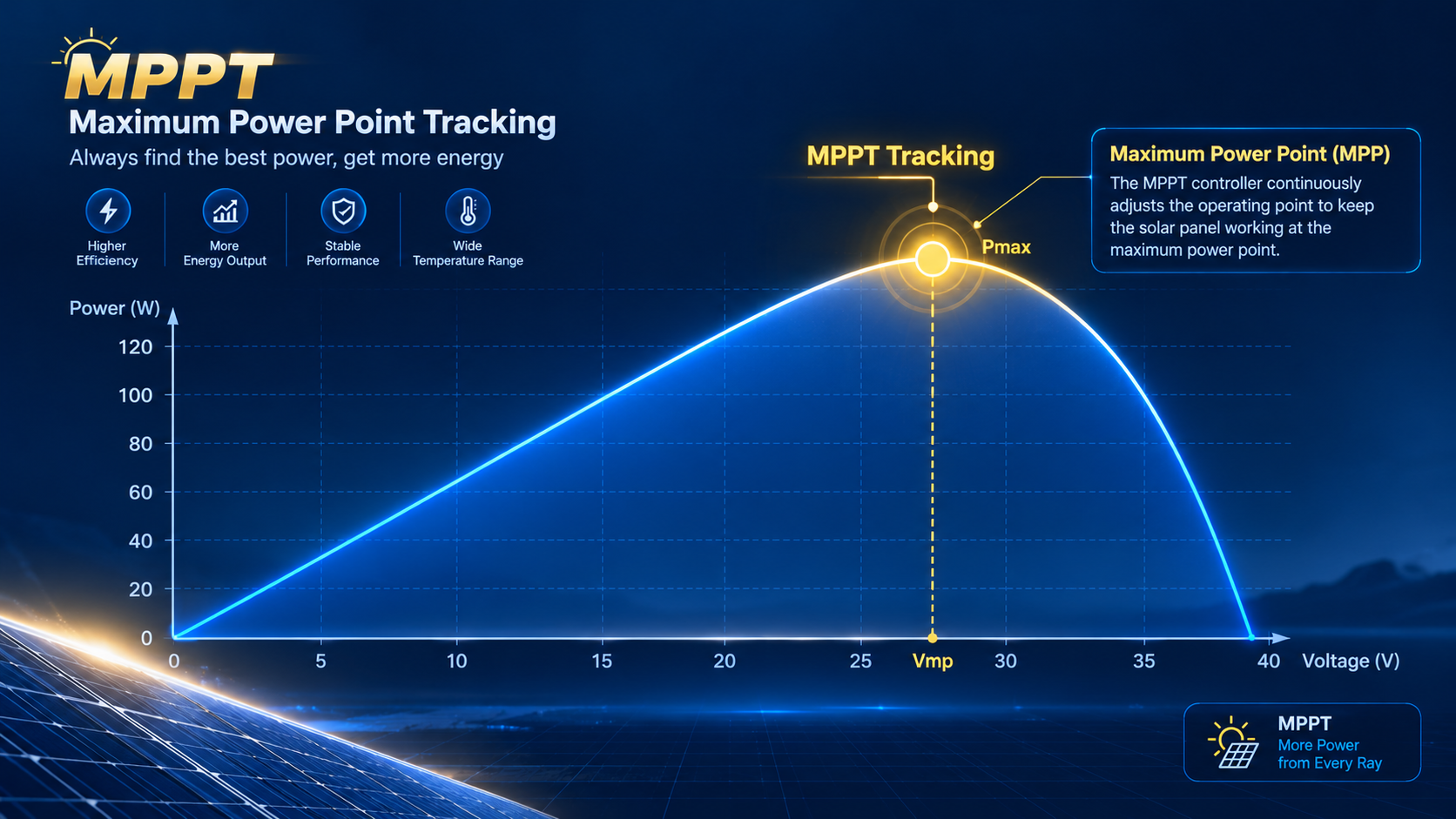
Solar panels exhibit non-linear output characteristics: at any given moment, as output voltage gradually rises from zero, output power first increases and then decreases, with a specific voltage point (the maximum power point) where output power reaches its peak. This point shifts in real time in response to changes in irradiance, temperature, shading conditions, and other factors.
The 1230-G's MPPT algorithm continuously monitors the solar panel's output voltage and current at millisecond-level response speeds, dynamically adjusting the operating point through proven algorithms like Perturb and Observe (P&O) to ensure the PV array consistently operates at maximum power output — extracting every usable watt from the solar panel.
Compared to traditional PWM controllers, MPPT technology can boost charging efficiency by 20% to 30% . This efficiency advantage becomes especially pronounced under rapidly changing light conditions — such as the transitional periods of dawn and dusk, overcast skies with fast-moving clouds, or environments with partial shading from trees or buildings. For solar-dependent street light systems, higher charging efficiency directly translates to shorter charging times, more fully charged batteries, and longer nighttime illumination duration. The system's autonomous operating capability during consecutive overcast or rainy days is also significantly enhanced.
If MPPT is the 1230-G's "high-efficiency charging engine," then the built-in step-up constant current LED driver is its "secret weapon" — the feature that sets it apart from the majority of solar controllers on the market.
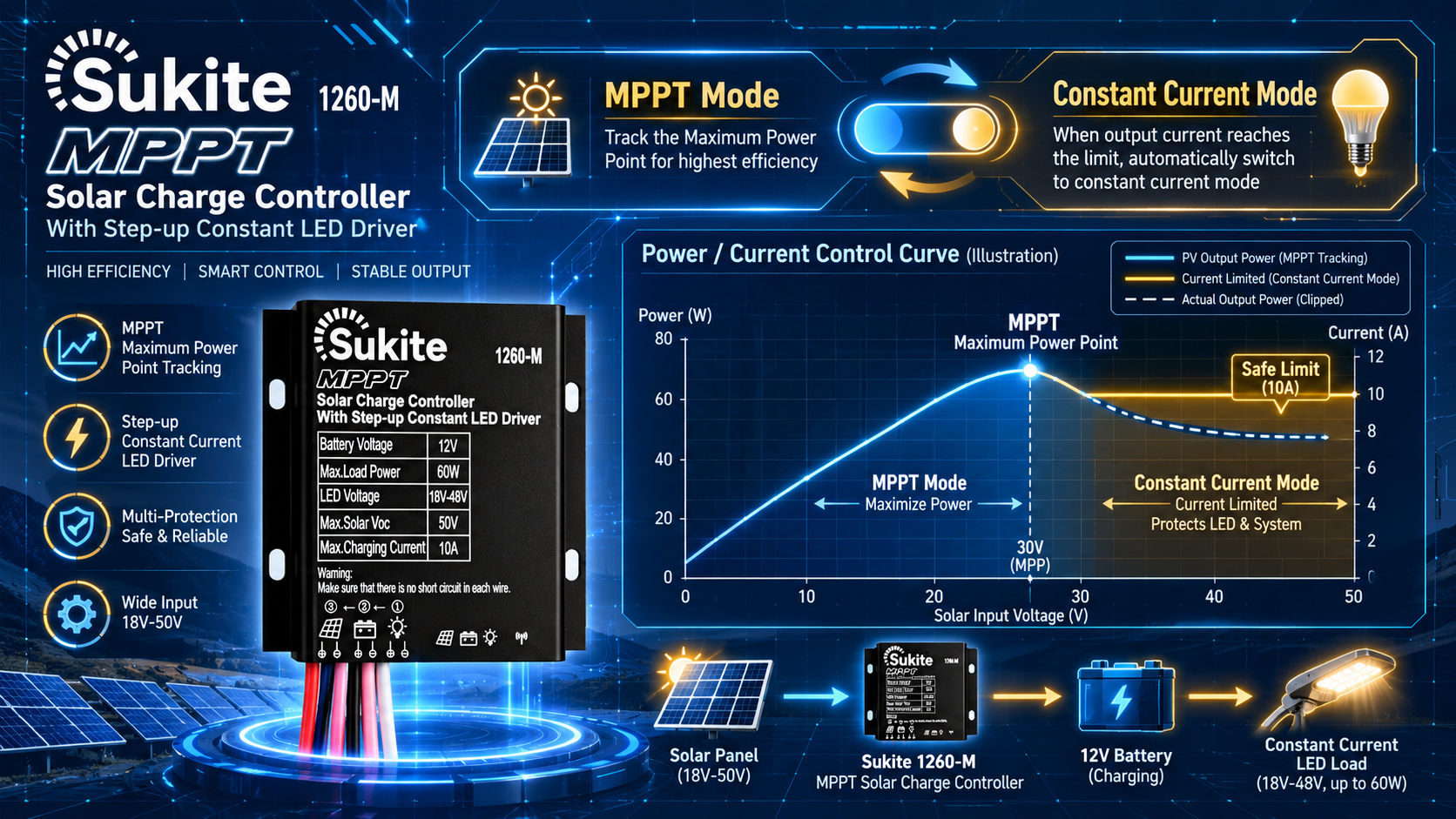
In traditional solar street light system architecture, the path from solar panel to illuminated LED involves the following chain: solar panel → controller (charge management) → battery → standalone LED driver power supply → LED luminaire. In this chain, the controller and driver are two separate devices, each with its own housing, terminals, and thermal design — adding procurement costs, consuming installation space, and introducing additional connection points and failure risks.
The 1230-G integrates the LED driver function directly into the controller, compressing the five-link chain into just: solar panel → 1230-G controller → battery and LED luminaire (both connected in parallel to the controller). Internally, the controller simultaneously handles "battery charge management" and "constant current LED drive output." This integrated design delivers multiple layers of value:
First, simplified system architecture. Users no longer need to separately select and configure an LED driver power supply, eliminating the complexity of equipment selection and matching. For installation projects in remote areas lacking professional electrical engineers, the simplified wiring process significantly lowers installation barriers and reduces error rates.
Second, reduced total cost. The 2-in-1 design reduces hardware costs including enclosure materials, terminals, and internal circuit boards — while also saving on installation labor and ongoing maintenance expenses. The entire street light system thus achieves a more competitive total cost of ownership.
Third, enhanced system reliability. Fewer devices and fewer connection points mean fewer potential failure points. In the integrated design, coordination between charge management and LED driving is internally orchestrated by the controller, avoiding compatibility issues and communication failure risks that can occur in split-component solutions.
Fourth, guaranteed lighting quality. Constant current drive ensures the LED string receives precise, stable current — no brightness fluctuations caused by battery voltage variations. This stable output not only improves user experience but, more importantly, protects LED chips from current surges, extending the luminaire's overall service life.
With its 30W load power, 12V system voltage, and built-in LED driver, the 1230-G offers distinct advantages in the following application scenarios:
Rural Road Solar Street Lights: This is the 1230-G's core target market. Across China and the world's vast rural areas, road lighting infrastructure still has significant gaps. A 30W LED luminaire sufficiently covers village-level road lighting needs for roads 3 to 5 meters wide with pole spacing of 6 to 8 meters. Paired with appropriately sized solar panels and batteries, a street light system driven by the 1230-G can achieve year-round stable operation without grid connection.
Courtyard and Campus Outdoor Lighting: Outdoor lighting for villa gardens, factory premises, school campuses, and park pathways typically demands both aesthetics and reliability, with relatively limited power requirements. The 1230-G's compact size and integrated design allow it to be discreetly concealed inside light poles or small distribution boxes without compromising the overall landscape.
Remote Off-Grid Public Lighting: In mountainous areas, islands, and pastoral regions without grid coverage, public lighting infrastructure is a fundamental need for improving residents' quality of life and safety. The 1230-G delivers complete charge/discharge management and lighting control functionality at low equipment cost — making it a cost-effective choice for such off-grid lighting projects.
Security Camera Auxiliary Lighting: In surveillance scenarios such as traffic checkpoints, perimeter security, and construction sites, nighttime auxiliary lighting is essential for camera image quality. The 1230-G can be paired with small solar panels and batteries to provide independent, self-sustaining nighttime lighting for surveillance points without the need for separate power cabling.
The Sukite 1230-G MPPT solar charge controller, with its integrated 2-in-1 design combining "high-efficiency MPPT charging" and "step-up constant current LED driving," precisely addresses the core needs of the small-to-medium power LED solar street light market. It is neither a standalone charge controller nor an independent LED driver power supply — it is a comprehensive control solution designed from a system-level perspective, purpose-built for real-world application scenarios.
For system integrators and contractors planning rural road lighting, campus outdoor illumination, or off-grid public lighting projects, the 1230-G offers a practical pathway to simplified system design, reduced overall costs, and enhanced operational reliability. As the solar street light industry evolves from "functionality" toward "quality," this product represents a pragmatic choice worthy of serious consideration.
Model: Sukite 1230-G MPPT Solar Charge Controller
Core Functions: MPPT Maximum Power Point Tracking + Step-up Constant Current LED Driver (18V-36V)
Target Applications: 12V Solar LED Street Light Systems and Small-to-Medium Power Outdoor Lighting (≤30W Load)
Manufacturer: Dongguan Sukite New Energy Lighting Co., Ltd. (Sukite)
Fill out the form below and our team will get back to you within 24 hours.
Your inquiry has been submitted successfully. Our team will contact you within 24 hours.