

Data from multiple leading research institutions corroborate this upward trend. Straits Research reports that the global solar charge controller market stood at $2.46 billion in 2025 and is expected to reach $5.0 billion by 2034, representing a CAGR of 8.2%. Research Nester projects the market will grow from $3.22 billion in 2025 to $18.14 billion by 2037, at a CAGR of approximately 15.3%.
While estimates vary slightly across research firms, they all point to the same conclusion: the solar charge controller market is on a strong upward trajectory. This growth is driven by three key factors: the accelerating global adoption of renewable energy, expanding demand for off-grid electrification, and the rising penetration of energy storage systems.
From a regional perspective, Asia-Pacific dominated the global market in 2025 with a 34.82% share, driven by large-scale PV deployments and rural electrification initiatives in China, India, and other countries in the region. Straits Research data similarly shows Asia-Pacific accounting for 39.2% of the global market.
North America demonstrated equally impressive performance. In the United States, clean energy policies and grid reliability concerns are driving widespread adoption of charge controllers across residential energy storage, RV, and telecommunications backup power applications. The U.S. solar charge controller market is expected to reach $920 million by 2032.
Europe benefits from distributed PV subsidies and self-consumption models, with countries including Germany, the UK, France, and Italy showing sustained demand growth for smart controllers. Meanwhile, emerging markets across Southeast Asia, Africa, and Latin America are becoming the fastest-growing demand regions, fueled by off-grid electrification and the proliferation of small-scale distributed systems.
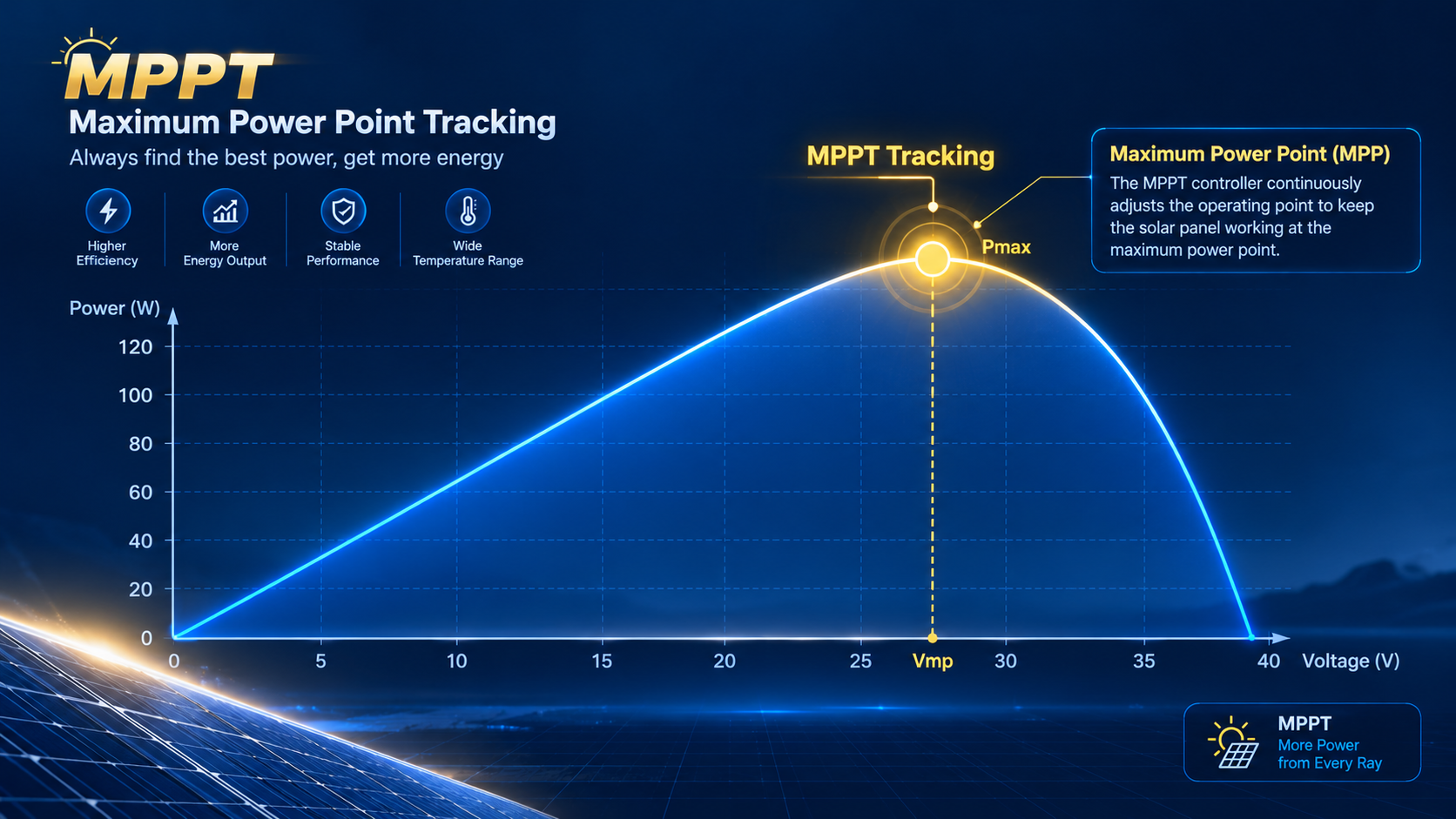
At the technology level, MPPT (Maximum Power Point Tracking) controllers are accelerating their displacement of traditional PWM (Pulse Width Modulation) controllers as the market mainstream, thanks to their superior energy conversion efficiency.
Industry data indicates that MPPT controllers can achieve charging efficiency of over 98% — outperforming PWM controllers by 20 to 30 percentage points. This efficiency advantage is particularly pronounced in environments with rapidly fluctuating light conditions. Currently, MPPT controllers are capturing an increasing share of the mid-to-high-end market, energy storage applications, and high-performance off-grid systems, while PWM controllers are increasingly confined to low-power, cost-sensitive applications.
Of particular note, smart controllers are emerging as the fastest-growing market segment. Controllers with integrated Bluetooth, Wi-Fi, RS-485, CAN bus, and cloud platform connectivity are becoming the industry standard. Through IoT technology, maintenance personnel can remotely monitor system status, diagnose faults, and optimize charging strategies — dramatically reducing on-site inspection costs.
The integration of artificial intelligence is further enhancing controller value. Machine learning models can analyze multidimensional data including current, voltage, and temperature to identify performance degradation, predict failures, and recommend maintenance actions before breakdowns occur. This capability is especially critical for large-scale deployments such as distributed streetlights, communication base stations, and off-grid power stations.
For solar charge controller manufacturers and system integrators, the current market sends clear signals:
MPPT is the mainstream track: As PV module efficiency improves and energy storage demand grows, MPPT controllers have become standard equipment — the market space for PWM will continue to contract.
Intelligence is the key differentiator: The era of pure hardware competition is ending. "Connected" controllers with remote monitoring, data analytics, and AI-powered predictive capabilities will define core competitiveness.
Emerging markets represent the growth frontier: The off-grid electrification wave across Southeast Asia, Africa, and Latin America offers vast growth opportunities for controller manufacturers. Those who can deliver cost-effective solutions adapted to harsh environments will gain first-mover advantage.
The global solar charge controller market stands at the beginning of a significant growth cycle. Whether it's Asia-Pacific's scale advantage, North America's technological leadership, or the growth potential of emerging markets, all point in the same direction: as an indispensable "intelligent brain" of PV systems, the charge controller is being redefined — evolving from a "balance of system component" to a "strategic control-layer device."
Data Sources: Publicly available industry research reports from Fortune Business Insights, Straits Research, Research Nester, GII (Global Information Intelligence), and other institutions.
Fill out the form below and our team will get back to you within 24 hours.
Your inquiry has been submitted successfully. Our team will contact you within 24 hours.