

September 9, 2026 — Amid the grand narrative of global energy transition, an easily overlooked reality persists: hundreds of millions of people worldwide still live beyond the reach of power grids. For them, off-grid solar systems are not a "clean energy choice" — they are the only source of electricity. And the solar charge controller, serving as the "brain" of off-grid PV systems, has become the critical bridge connecting sunlight to usable power.
According to the latest research from GlobalInfoResearch, the global off-grid MPPT solar charge controller market is projected to reach $2.123 billion by 2032**, growing at a compound annual growth rate of **7.1%** during the forecast period from 2026 to 2032. In 2025, global shipments of off-grid MPPT controllers reached approximately **7.5535 million units**, with an average global market price of around **$168.2 per unit. Behind this growth trajectory lies surging demand driven by the off-grid electrification wave.
The structure of an off-grid PV system appears simple — solar panels, batteries, loads — but without a controller, this system simply cannot operate safely.
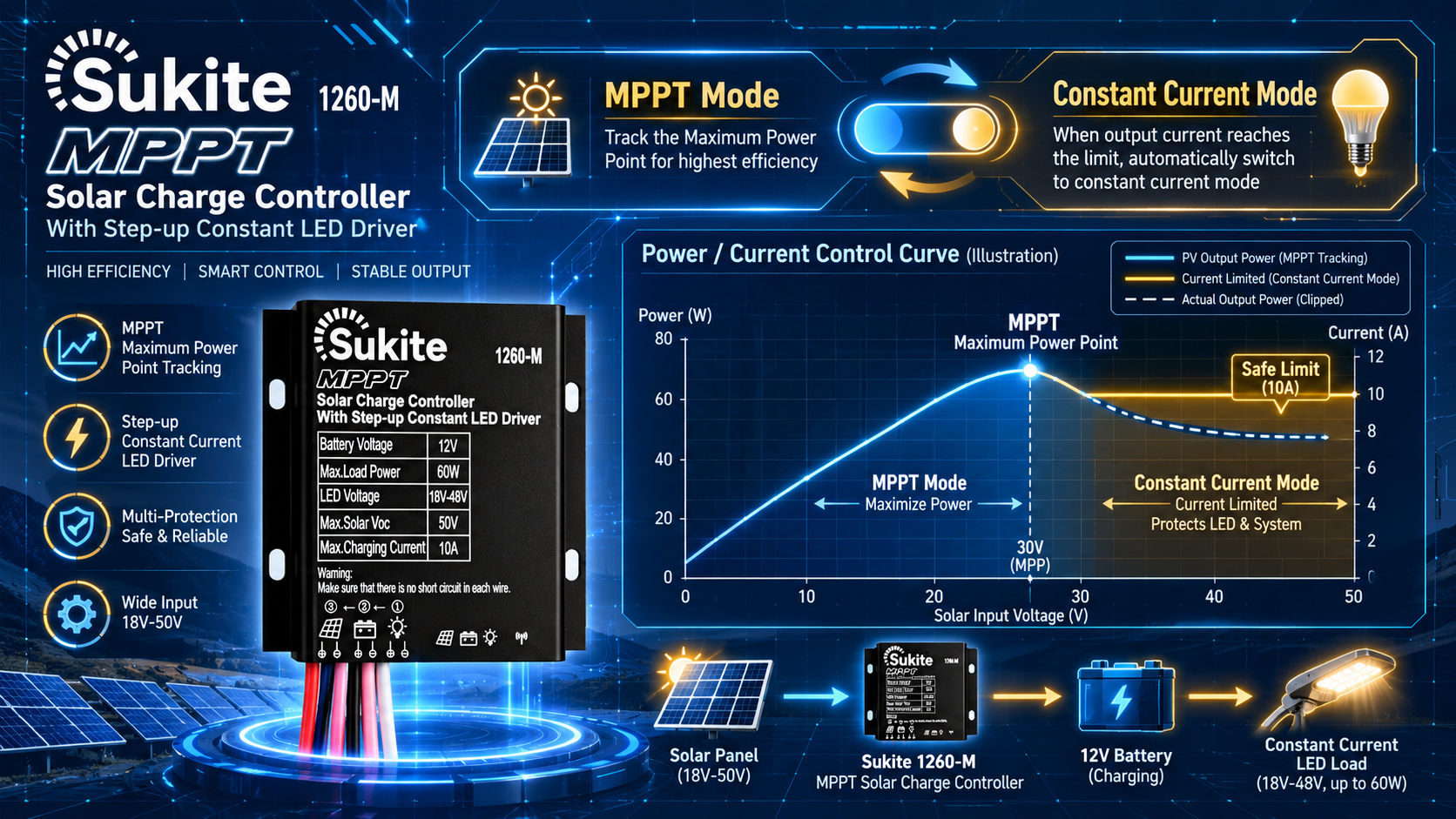
The solar charge controller is the "smart brain" of off-grid systems. It is not a simple switching device but a core power electronic component connecting solar panels to batteries. Through complex topological structures and control algorithms, it prevents batteries from suffering lifespan degradation due to overcharging or over-discharging, while effectively blocking reverse current at night. This protection mechanism is particularly critical for remote base stations, household power systems, and outdoor lighting facilities that rely on solar as their sole power source — it directly determines battery service life and the entire project's return on investment.
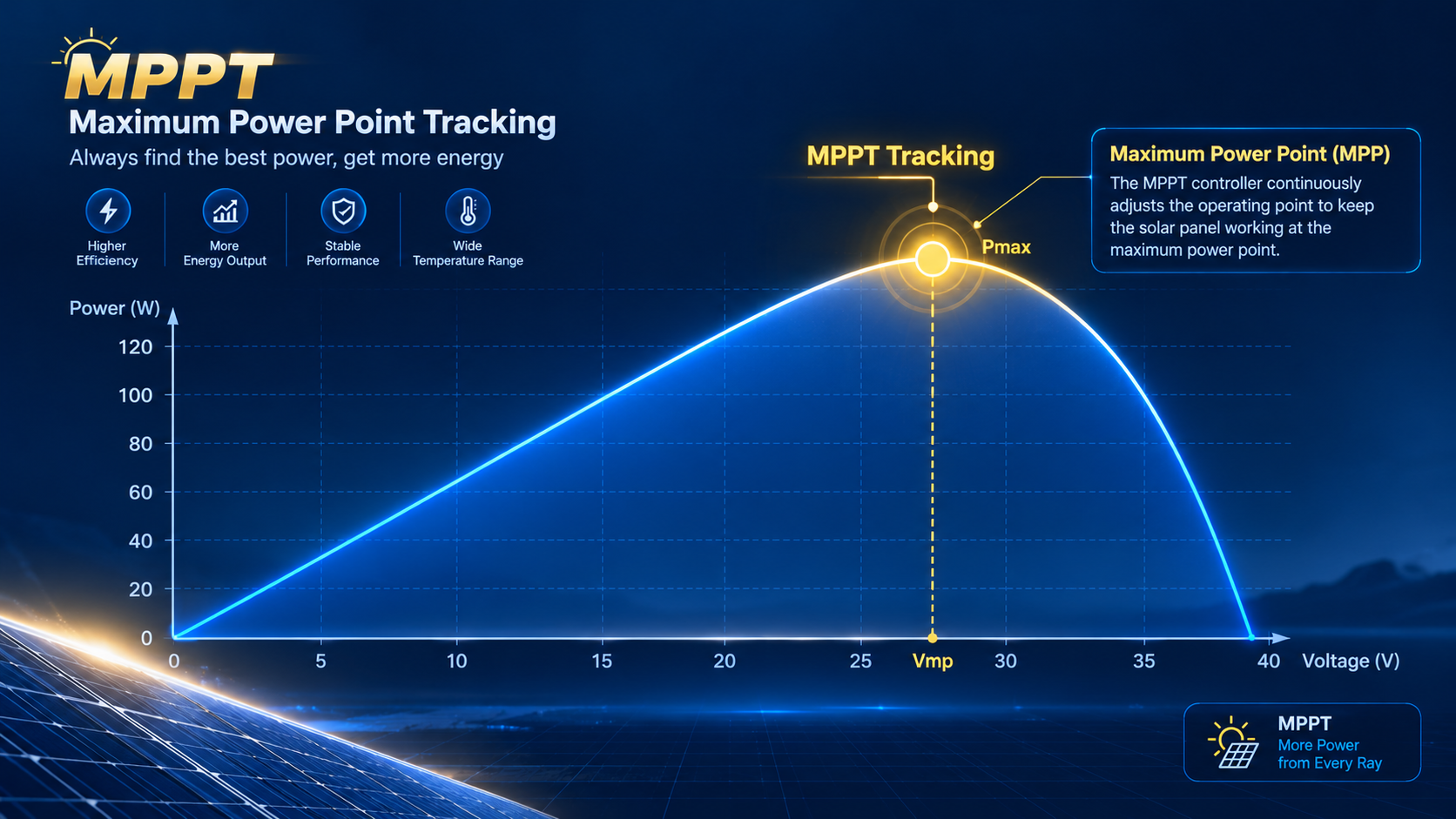
Modern controllers have evolved from single-function voltage regulators into comprehensive platforms integrating Maximum Power Point Tracking, intelligent communication, and hybrid energy management. MPPT controllers, in particular, can dynamically track the solar panel's maximum power point under varying conditions such as changing sunlight angles and partial shading, converting unstable DC output into stable voltage and current suitable for battery charging, ensuring efficient system operation across diverse climate conditions.
In short: an off-grid PV system without a controller is like a car without brakes and a steering wheel — it can move, but you wouldn't want to use it.
Demand for off-grid MPPT controllers spans multiple scenarios, but the core driver stems from a common context — "no grid" or "unreliable grid" :
The global energy system is accelerating its shift toward distributed models, driving continued growth in off-grid solar installations, particularly in rural and energy-deficient regions. In communities where grid expansion costs are prohibitive, off-grid solutions represent the only economically viable power source.
In remote mountainous areas, deserts, and islands, telecom base stations, weather monitoring stations, and environmental sensors require independent power supplies. Off-grid MPPT controllers must support long-term stable operation under extreme temperatures and feature ultra-low standby power consumption to maximize battery life.
With the rise of mobile lifestyles, demand for off-grid solar systems in RVs, boats, and outdoor camping continues to grow. These applications require compact, lightweight, easy-to-install controllers with high protection ratings to withstand humidity, vibration, and other environmental challenges.
Scenarios such as oil and gas pipeline cathodic protection, remote mining operations, and agricultural irrigation also rely on off-grid solar power systems. These applications demand controllers capable of reliable operation in extreme temperatures, high altitudes, and corrosive environments.
The off-grid solar sector is undergoing a battery technology transformation — lithium iron phosphate batteries are accelerating the replacement of traditional lead-acid batteries.
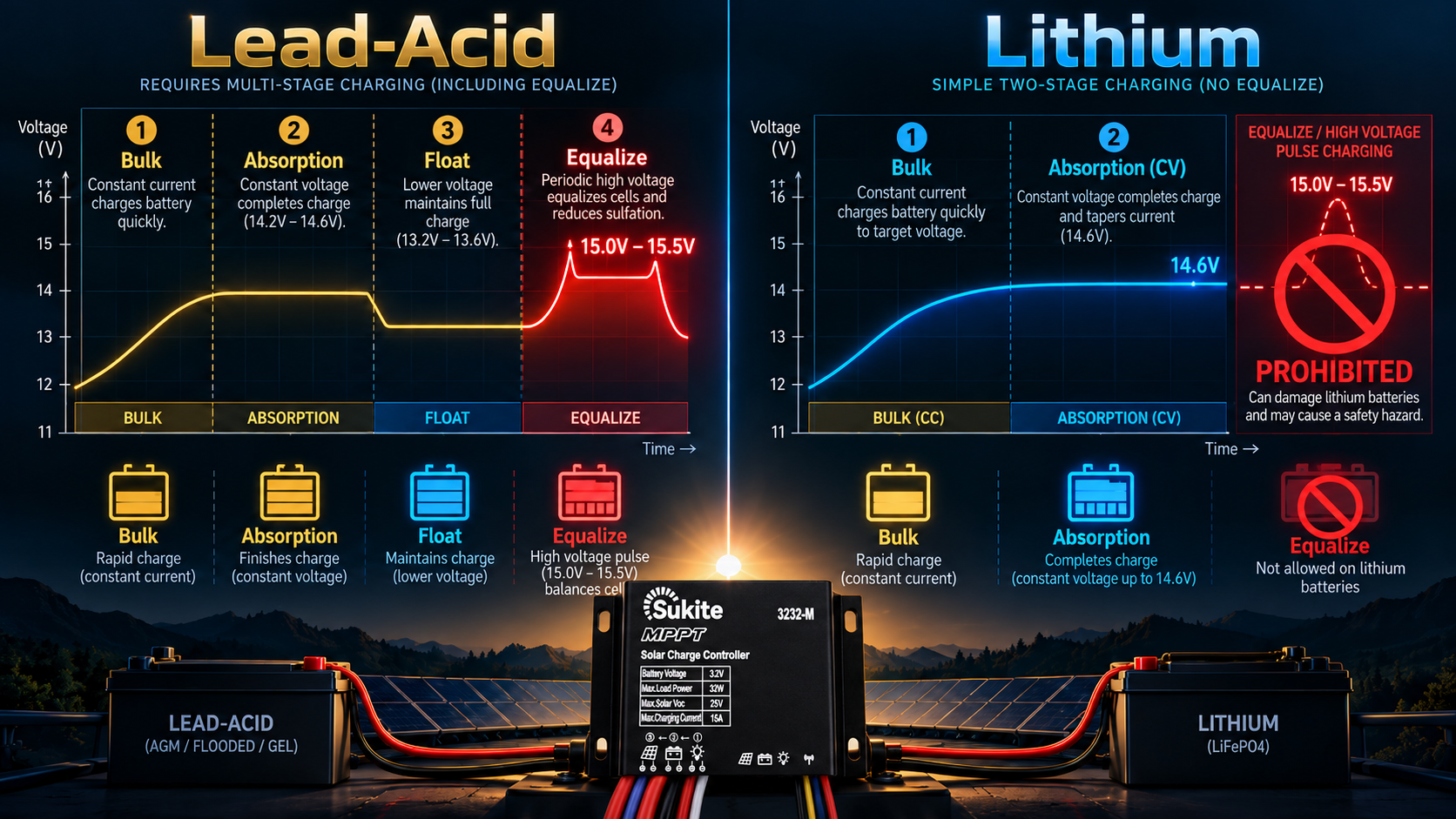
Compared to lead-acid batteries, LiFePO₄ batteries offer longer cycle life (2000+ cycles), higher energy density, and superior charge/discharge efficiency. However, this also introduces new requirements for controllers:
Programmable charging curves are essential. LiFePO₄ charge/discharge characteristics differ fundamentally from lead-acid, with greater sensitivity to overcharging. Controllers must offer charging algorithms specifically tailored to LiFePO₄, precisely controlling voltage and current to prevent overcharging, deep discharge, and thermal stress — thereby extending battery life.
BMS communication capability is needed. Modern off-grid systems require controllers to communicate with Battery Management Systems, accessing real-time battery status data for more precise charge/discharge management. Traditional lead-acid battery controllers can no longer meet the requirements of emerging chemical energy storage systems.
This trend is driving controller manufacturers to offer programmable charging curves, temperature compensation, and BMS integration — shifting competition from hardware to software and services.
Asia-Pacific dominates the global off-grid MPPT controller market. China has become a global industry hub, leveraging strong manufacturing capabilities and domestic PV installation demand, while rural electrification programs in countries like India provide substantial incremental market space.
Regions with weak power infrastructure — the Middle East, Africa, and Latin America — maintain rigid growth in demand for off-grid and emergency controllers, making them blue-ocean markets where major manufacturers are competing fiercely. The high temperatures and dusty environments in these regions impose higher requirements on controller protection ratings and reliability.
North American and European markets show a preference for high-value-added products, with emphasis on technology iteration and deep integration with smart control. Users are willing to pay premiums for environmental certifications and premium brands. RVs, marine applications, and residential energy storage are key demand sources.
For solar charge controller manufacturers and system integrators, the off-grid electrification wave sends clear signals:
MPPT is the off-grid standard: In off-grid scenarios with highly variable light conditions, the 20%-30% efficiency advantage of MPPT directly determines whether a system can survive consecutive cloudy days. MPPT controllers have become the standard, not an "upgrade option."
Intelligence is the key differentiator: Controllers with remote monitoring, IoT connectivity, and data analytics capabilities translate to dramatically lower operational costs for off-grid projects spread across vast areas.
LiFePO₄ compatibility is the "entry ticket": With the rapid penetration of LiFePO₄ in off-grid systems, controllers lacking lithium battery charging curve optimization and BMS communication capabilities will be phased out.
Localized adaptation is a competitive advantage: Rugged designs for high-temperature, high-humidity, and dusty environments, combined with local certification compliance, will secure first-mover advantages in growth markets like Africa and Southeast Asia.
Off-grid electrification is not just a commercial market — it is a global mission affecting the quality of life for hundreds of millions. The solar charge controller, as the "brain" of off-grid PV systems, plays an indispensable role in this mission.
As global renewable energy penetration continues to rise, LiFePO₄ battery costs decline, and IoT technology further enables smart capabilities, the off-grid MPPT controller market is evolving from a "niche segment" into a "strategic growth pole." For manufacturers like Sukite that are deeply engaged in this space, this is not merely a business opportunity — it is a mission to connect sunlight to power and light up the unlit corners of the world.
Data Sources: GlobalInfoResearch "Global MPPT Solar Charge Controllers for Off-Grid Supply, Demand and Key Producers, 2026-2032," QYResearch, Straits Research, IEA, and other publicly available industry research reports.
Fill out the form below and our team will get back to you within 24 hours.
Your inquiry has been submitted successfully. Our team will contact you within 24 hours.